TL;DR: AI agent builders let you create autonomous AI systems that plan, use tools, and complete multi-step tasks without hand-holding every step. The best platforms in 2026 are LangGraph for developers who want full control, CrewAI for multi-agent team setups, OpenAI Assistants API for quick prototyping, and n8n AI agents for no-code automation. Your best choice depends on whether you're a developer, a technical operator, or someone who needs agents without writing code.
A year ago, "AI agent" mostly meant a chatbot that could search the web. In 2026, the category has matured dramatically. AI agents now book meetings, audit codebases, monitor competitors, draft contracts, triage customer tickets, and orchestrate other agents — all without a human in the loop for every step.
The tools that make this possible have grown up just as fast. What was a fragmented, experimental ecosystem in 2024 is now a genuine product category with clear leaders, distinct trade-offs, and enough real-world deployments to draw meaningful conclusions from.
Here's what's actually worth your time.
---
What Is an AI Agent Builder?
Before comparing tools, let's be precise about what we mean. An AI agent is an AI system that can:
- Reason about a goal and break it into steps
- Use tools (search, code execution, APIs, file systems) to gather information and take actions
- Iterate — observe the result of each action and decide what to do next
- Complete tasks autonomously, looping until the goal is achieved or it determines it can't proceed
An AI agent builder is a platform, framework, or API that makes it significantly easier to construct, deploy, and manage these systems — rather than building agent logic from scratch.
The spectrum runs from full developer frameworks (you write the orchestration code) to no-code visual builders (you drag and drop workflows). Most serious production deployments in 2026 fall somewhere in the middle.
---
Top AI Agent Builders Worth Using in 2026
1. LangGraph (by LangChain)
LangChain started as a simple library for chaining LLM calls. LangGraph, its agent-focused successor, has become the most widely adopted framework for production AI agents among developers.
LangGraph models agent behavior as a state graph — nodes represent actions or decisions, edges represent transitions between them, and the graph tracks state across the entire agent run. This gives you fine-grained control over agent behavior, cycle detection, and human-in-the-loop checkpoints that simpler agent frameworks lack.
Best for: Developers building production agents with complex workflows, long-running tasks, or requirements for monitoring and observability. LangGraph's deployment platform (LangGraph Cloud) handles persistence, scheduling, and streaming out of the box. Strengths: Mature ecosystem, excellent documentation, strong community, works with any LLM provider, best-in-class observability through LangSmith. Weaknesses: Requires real Python or JavaScript experience. The graph mental model has a learning curve. Overkill for simple single-agent tasks. Pricing: Open-source framework (free). LangGraph Cloud has a generous free tier with paid plans for production scale.---
2. CrewAI
If LangGraph is about controlling a single agent precisely, CrewAI is about deploying a team of agents with defined roles. You define a crew — a researcher, a writer, a fact-checker — assign each a role and a set of tools, then let them collaborate on a shared goal.
The multi-agent paradigm maps naturally to many real business workflows. A content production crew might have an agent that researches a topic, one that drafts the piece, and one that edits for tone — each operating semi-independently and passing outputs to the next.
CrewAI has seen massive adoption in 2025–2026, particularly for business automation use cases. Their visual canvas for designing crews has made the framework accessible to people who aren't comfortable writing orchestration code from scratch.
Best for: Teams building automation workflows that map to human team structures — research pipelines, content workflows, sales intelligence, customer success operations. Strengths: The role-based model is intuitive. Built-in support for sequential and parallel task execution. Active community with hundreds of pre-built agent templates. Weaknesses: Less granular control than LangGraph. Multi-agent coordination overhead can make simple tasks slower and more expensive than they need to be. Pricing: Open-source framework (free). CrewAI Enterprise for managed deployment and monitoring.---
3. OpenAI Assistants API
If you're prototyping quickly or building on top of GPT-4o and o3, the OpenAI Assistants API is the fastest path from idea to working agent. Assistants handles thread persistence, file retrieval, code execution, and tool calling — the boilerplate that would otherwise take days to build.
The tradeoff is lock-in and limited control. You're working within OpenAI's architecture, using OpenAI's models, and trusting their infrastructure. For many use cases, that's perfectly fine. For applications with complex control flow, multi-agent coordination, or requirements to use non-OpenAI models, it gets restrictive quickly.
Best for: Rapid prototyping, internal tools, and production agents that will live entirely within the OpenAI ecosystem. Strengths: Fastest time to working prototype. Thread management, file handling, and code execution included. Easy integration with GPT-4o's native tool use. Weaknesses: Vendor lock-in. Less flexible than framework-based approaches. Pricing can escalate significantly at scale. Pricing: Usage-based. Token costs vary by model; storage for thread history is metered separately.---
4. n8n AI Agents
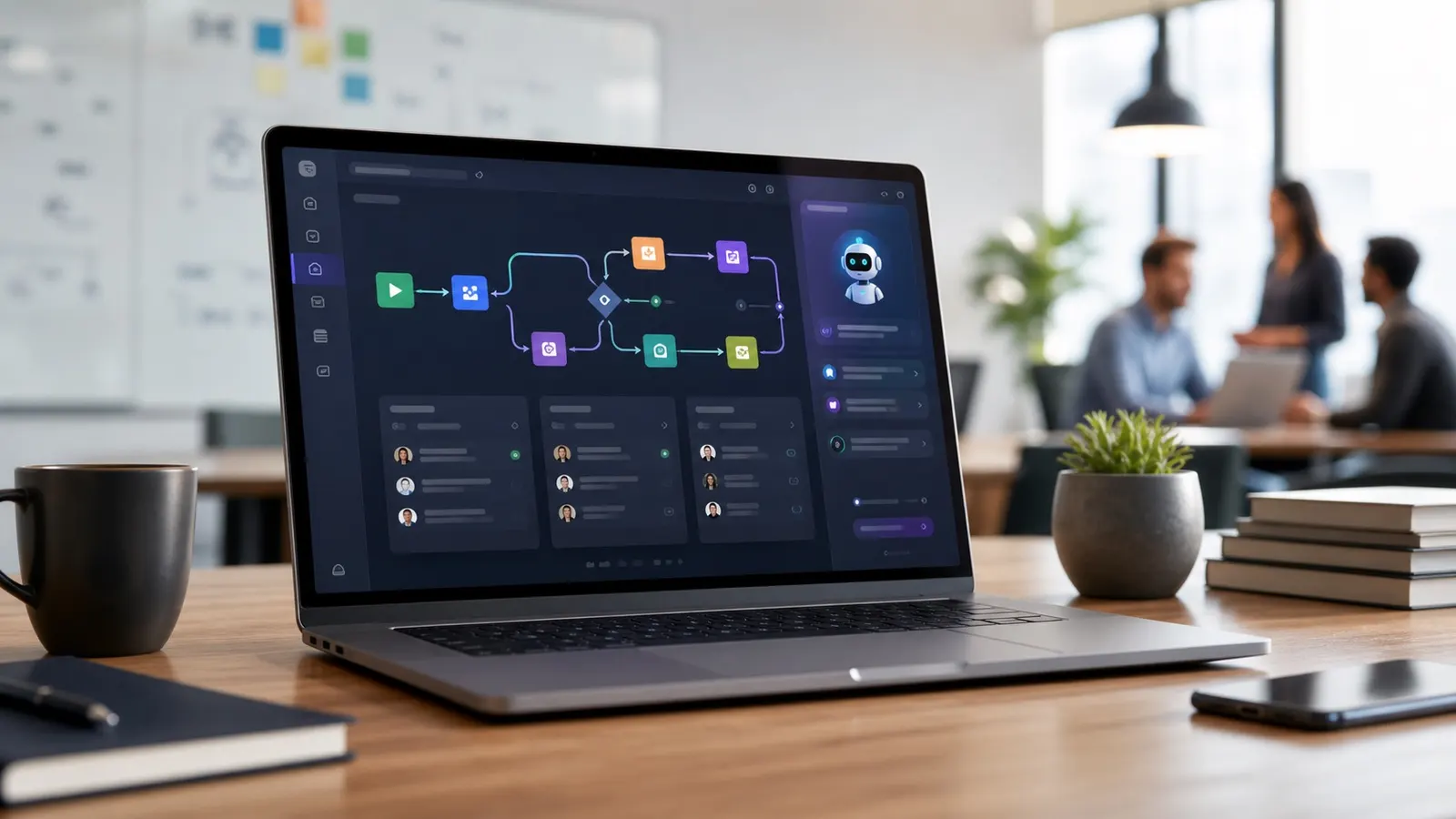
n8n has been a popular open-source workflow automation tool for years. Their 2025 AI agent nodes transformed it into a serious contender for teams that want agent capabilities without writing code.n8n lets you build agent workflows visually — connect a trigger (a new email, a Slack message, a form submission) to an AI agent node that can reason and use tools, then route the output to any downstream action (create a Notion page, send a reply, update a CRM record). The agent node handles tool calling and iterative reasoning; you handle the integration logic visually.
For operations teams, marketing teams, and technical-but-not-developer profiles, n8n AI agents hit a sweet spot that pure developer frameworks miss. If your needs are simpler than full agents, our best AI workflow automation tools guide covers Zapier, Make, and other options that connect apps without code.
Best for: Business automation with AI reasoning embedded in existing workflows. Teams that already use n8n for automation and want to add intelligence. Non-developers who need agent capabilities integrated with SaaS tools. Strengths: 400+ pre-built integrations. Visual workflow design. Self-hostable for data privacy. Free and open-source self-hosted tier. Weaknesses: Complex multi-agent architectures get unwieldy in a visual editor. Less performant than code-first frameworks for high-throughput applications. Pricing: Free self-hosted. Cloud plans from $20/month.---
5. Vertex AI Agent Builder (Google Cloud)
For organizations already running on Google Cloud, Vertex AI Agent Builder has become the enterprise choice. It integrates with Google's Gemini 2.0 models, native grounding through Google Search, and enterprise data sources like BigQuery and Cloud Storage.
The managed infrastructure is the real selling point. Vertex handles scaling, logging, latency optimization, and compliance controls — the operational overhead that makes running production agents at enterprise scale painful with open-source frameworks.
Best for: Enterprise teams on Google Cloud with compliance requirements and existing GCP data infrastructure. Strengths: Managed infrastructure, strong security controls, native integration with Google Workspace, Gemini 2.0 grounding. Weaknesses: Google Cloud lock-in. More expensive than open-source alternatives. Configuration can be complex for simple use cases. Pricing: Usage-based; varies significantly by model and tool use.---
How to Choose the Right Platform
The decision tree is simpler than it looks:
Are you a developer who needs production-grade control? → LangGraph Do you need multiple agents collaborating on structured workflows? → CrewAI Are you prototyping fast and living in the OpenAI ecosystem? → OpenAI Assistants API Do you need agent reasoning embedded in no-code business automation? → n8n Are you an enterprise on Google Cloud with compliance requirements? → Vertex AI Agent Builder---
What Makes a Good AI Agent in Practice
The platform matters less than most people assume. What separates effective agents from expensive failures:
Clear task boundaries. Agents that know exactly when they're done (and when they're stuck) outperform agents given vague open-ended goals. "Research the top 10 competitors in the B2B SaaS project management space and output a structured comparison table" is a good agent task. "Help us understand our competitive landscape" is not. Tool selection. An agent is only as capable as the tools it can use. Most platforms let you add custom tools — your internal APIs, databases, or proprietary data sources. The best agent deployments build tight tool sets tuned to specific tasks rather than giving agents access to everything and hoping for the best. Guardrails and human handoffs. Production agents need clear tripwires — conditions under which they pause and hand off to a human rather than proceeding autonomously. A customer service agent should escalate to a human when a refund request exceeds a threshold. A research agent should flag when it can't find authoritative sources. Plan these before you deploy. Cost visibility. Multi-step agents can burn tokens quickly, especially when they loop or use expensive reasoning models for every step. Build cost monitoring in from the start. Tools like LangSmith and Helicone provide per-run cost tracking that prevents unpleasant surprises.---
AI Agents for Non-Technical Teams
Not every agent deployment requires engineering resources. If you're on a team without dedicated developers, a few paths are worth knowing:
Zapier AI Agents — Zapier added agent capabilities to their automation platform, making it accessible to anyone comfortable building Zaps. The natural language interface for agent design is genuinely useful for non-technical operators. Microsoft Copilot Studio — For organizations already on Microsoft 365, Copilot Studio lets you build custom agents without code, with tight integration to SharePoint, Teams, and Dynamics. The enterprise compliance controls are a real differentiator. Relevance AI — A no-code agent builder that's found strong adoption among sales and marketing teams. Their pre-built agent templates for lead research, outreach, and CRM enrichment ship with sensible defaults that work without configuration.A solid home office setup helps when you're spending time configuring and testing agents — a good ergonomic chair and a second monitor pay for themselves quickly when you're running long agent test sessions.
---
What's Coming Next for AI Agents
The trends shaping the next 12–18 months:
Agent-to-agent communication standards. Right now, multi-agent systems are largely proprietary — CrewAI agents can't natively collaborate with LangGraph agents. Emerging standards like the Model Context Protocol (MCP) and Google's Agent-to-Agent (A2A) protocol aim to change this. When they mature, expect agent ecosystems that work more like microservices — interoperable, composable, and independently deployable. Persistent memory. Most agents today are stateless across sessions. The next generation will maintain long-term memory about users, past tasks, and organizational context. This is already emerging in tools like Mem0 and in LangGraph's persistence layer. Specialization over generality. Just as the AI writing assistant market fragmented into tools for fiction writers, marketers, and legal drafters, the agent market is fragmenting into vertical specialists. Agents built specifically for financial analysis, software QA, or supply chain management will outperform general-purpose agents on domain tasks.---
The Bottom Line
AI agents have crossed the threshold from interesting experiment to genuinely useful business tool. The platforms are mature enough to deploy in production. The failure modes are well-documented. The ROI cases are real.
The 2026 question isn't "should we explore AI agents?" — it's "which platform fits our team's skills and use case?" Start with one concrete, well-scoped task, deploy an agent to handle it, measure the results, and expand from there. The teams seeing the biggest gains aren't the ones who built the most ambitious agent architectures — they're the ones who shipped something simple and iterated fast.
---
Related reading: Best AI Code Assistants in 2026 | AI Productivity Tools for Entrepreneurs